Bible Trivia Quiz Game
- 4.8
- Rating
- 100.00K
- Installs
- Free
- Price
 Analysis by App-foxy
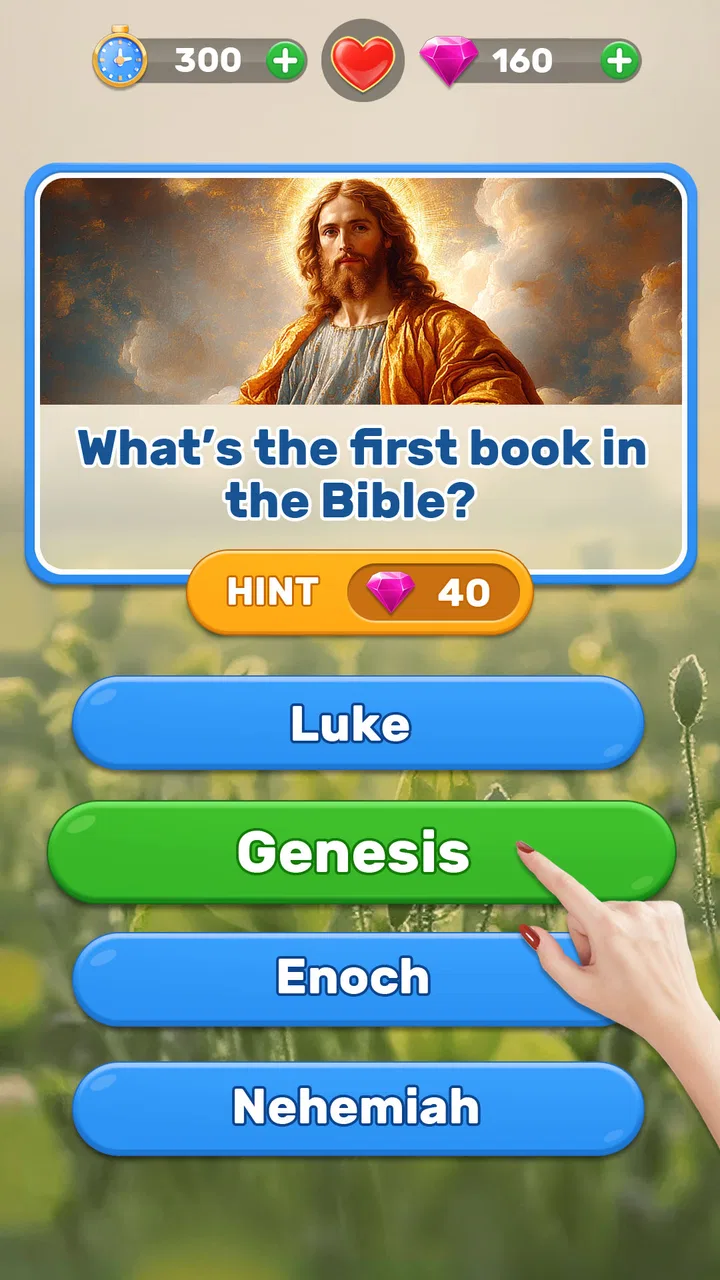
I approached Bible Trivia Quiz Game expecting a simple way to test familiar Bible knowledge, but it works best when treated as a small, repeatable trivia habit rather than a full study course. It is a free trivia game from Floral Game, aimed at everyone, and its central appeal is easy to understand: open it, answer questions, and see how well your memory holds up.
That simplicity is both its strength and its limitation. I can imagine using it during a quiet coffee break, before a Bible study meeting, or with family members who want a light activity that still has a meaningful subject. At the same time, anyone looking for detailed explanations, a structured reading plan, or a serious replacement for Bible study will probably need something more substantial alongside it.
How the game feels in its current form
The most appealing part of the experience is the low barrier to entry. There is no complicated setup to understand before getting started, and the subject gives each question more weight than an ordinary general-knowledge quiz. Even when I know an answer immediately, the format encourages me to pause and distinguish between what I genuinely remember and what merely sounds familiar.
You May Also Like

 AccuWeather: Weather Radar
AccuWeather Review: A Quick, Clear Forecast for Everyday Decisions
For everyday plans, the best forecast is the one you can understand quickly. AccuWeather makes rain timing, radar, and local conditions easy to act on, with a few trade-offs.

 Hill Climb Racing
Why Hill Climb Racing Still Turns Crashes Into One More Run
A tiny car, a bumpy hill and one more upgrade: Hill Climb Racing keeps resurfacing because its simple chaos makes every near-miss feel personal.

 AliExpress - Shopping App
AliExpress Makes Global Shopping Feel Personal, but Shoppers Bear the Risk
AliExpress turns a global marketplace into a pocket-sized discovery engine. Its reach is useful, its shopping loop compelling, and its trade-offs easy to miss.

 Lords Mobile: Kingdom Wars
Lords Mobile Is a Kingdom-Building Routine, Not a Quick Match
A case-by-case verdict on the building, battles, device demands, and social commitments that make Lords Mobile rewarding for some players and exhausting for others.

 PDF Scanner app - TapScanner
TapScanner Makes Paperwork Easier to Capture, Check, and Share
TapScanner makes scanning with a phone feel less like a rescue operation and more like a dependable step in getting work done. Its capture tools are useful, though not flawless.

 Block Blast!
 Shows How Much a Puzzle Game Can Leave Out
A quiet grid game shows why puzzle players increasingly value instant clarity, repeatable skill and low-pressure play—and where the genre still needs to catch up.
More From Our News Desk
View All News


The game belongs firmly to the Bible trivia niche rather than the broader world of educational Bible apps. That distinction matters. A trivia game is useful for recall, recognition, and friendly competition, but it does not automatically provide context. If I miss a question, I want to know why the correct answer is right, where the event appears in Scripture, and whether the wording involves a translation difference. A quiz can expose a gap in memory; it cannot, by itself, fill every gap.
For casual players, that focused scope is welcome. I do not have to commit to a long reading session or work through a lesson before enjoying the app. A few questions can fit into an otherwise empty moment. The experience also suits people who already know the main stories and characters but want a quick way to keep those details active.
The public response suggests that the game has found an audience. It carries a 4.8 average from around 7,300 ratings, with more than 300 written reviews, and has passed 50,000 installs. Those figures do not prove that every player will enjoy it, but they do indicate that the basic idea is connecting with many users.
A useful companion, not a complete study tool
I would recommend it most strongly to three kinds of players. First are beginners who want a friendly introduction to major biblical facts without opening a dense reference work. Second are regular churchgoers who enjoy testing themselves after reading or discussion. Third are families and small groups looking for a simple conversation starter that does not require everyone to prepare in advance.
It is less suitable for a reader who wants a carefully sequenced understanding of the Bible. Someone studying a particular book, comparing passages, or investigating historical and theological context will get more value from a dedicated Bible app, commentary, or study resource. The quiz format can support that work, but it should not be mistaken for it.
One practical way to use it is as a warm-up. Before a group discussion, I could play a short session and note which topics feel weak. Instead of treating the score as a final judgment, I would use missed answers to choose what to read afterward. That turns the game into a diagnostic tool: it points toward areas worth revisiting without pretending to replace the reading itself.
What the version and release details tell me
The game was released on August 13, 2025, and the current version is 3.6. That combination suggests a product that has already moved beyond its first launch build. I would view the version number as evidence of ongoing iteration, but not as proof of any particular new feature. Without assuming that every update changes the visible gameplay, the current release is the one that matters to anyone deciding whether to install it today.
For existing players, a later version can make the experience feel more settled than an early release. It may reflect adjustments to presentation, question handling, stability, or general usability, but I would not promise a specific improvement unless the developer explains it directly. The sensible approach is to judge the current build on what it does now, while recognizing that Floral Game has continued developing the title after launch.
This is also why I would not base a decision on the release date alone. A recent game can still have a narrow question pool or limited depth, while an older app can be more mature and better organized. Here, the important question is whether the quiz remains enjoyable after the novelty fades. If the same player returns often, variety and clarity become more important than the fact that the app is relatively new.
How I would fit it into everyday use
Imagine a parent waiting outside a school activity with a child who enjoys Bible stories. A short round can fill the waiting time without requiring a book, a long video, or a competitive multiplayer setup. The parent can answer alongside the child, explain unfamiliar names, and turn a missed question into a quick conversation. Because the content rating is Everyone, it is positioned for broad household use, although adults should still adapt the discussion to the child’s age and knowledge.
Another realistic routine would be a personal review session after reading a chapter. I would play only briefly, then write down the topics I missed. The important discipline is to stop the quiz from becoming a guessing exercise. If I keep tapping until I get lucky, the score tells me very little. If I use mistakes as prompts to return to the text, the same session becomes much more useful.
For a church group, the game could work as an informal opener, but I would avoid making the score the center of the meeting. Trivia can energize a room, yet it can also make less confident participants withdraw if knowledgeable players dominate. A better use would be to discuss the reasoning behind an answer and allow people to contribute what they remember, rather than treating speed as the only sign of understanding.
There is also a good solo use case for people who prefer small goals. Instead of trying to complete a long course, I can make a habit of opening the game when I have a few spare minutes. That makes it approachable for users who struggle to maintain a daily reading routine. The trade-off is that short quizzes encourage breadth and recognition more naturally than deep concentration on one passage.
Three habits that make the quiz more valuable
Use wrong answers as a reading list. This is the most important improvement I would make to the basic experience. I would keep a short note of subjects that repeatedly cause trouble—names, locations, family relationships, or event order—and revisit those passages later. The game then becomes a filter for attention rather than a closed loop of questions and scores.
Separate confidence from correctness. Before selecting an answer, I would decide whether I am certain, partly sure, or guessing. That small pause reveals a different kind of weakness: sometimes I choose correctly for the wrong reason, while other times I reject the right answer because its wording feels unfamiliar. This is especially useful when playing with someone who knows many stories but mixes up details.
Change the social role of the app. Instead of asking who achieved the highest score, I would ask each player to explain one answer. That approach makes the game more welcoming and exposes whether the group understands the subject or is simply recognizing familiar phrases. It also gives the app value in a family setting even when participants have very different levels of knowledge.
A fourth useful habit is to avoid playing while distracted. Trivia looks like a good multitasking activity, but interruptions can make mistakes feel random. If I want an honest measure of recall, I would play in a quiet moment and treat each round as a small concentration exercise. If I only want entertainment, I would accept that the result is casual and not overinterpret it.
Where the experience may fall short
The central weakness of any focused quiz game is repetition. Once a player has seen a large portion of the available material, the challenge can shift from remembering Bible knowledge to remembering the app’s question wording. That is not necessarily a problem for occasional users, but frequent players will notice it sooner. Variety is therefore more important here than in a one-time casual game.
Another limitation is the difference between an answer and an explanation. A correct choice can settle the round, but it may leave a beginner unsure about the surrounding story. If the game does not provide enough context for a missed question, I would need to switch to a Bible or reference app to understand the lesson properly. That extra step is manageable, but it means the quiz is best used as part of a small workflow rather than alone.
Interpretation can also matter. Biblical questions sometimes depend on translation, terminology, or how a passage is summarized. A player may know the underlying story and still find a particular answer confusing because the wording emphasizes a different detail. I would treat ambiguous moments as invitations to check the source text, not as automatic evidence that a player lacks knowledge.
The free price makes trying it easy, but in-app purchases range from $0.99 to $49.99 per item. That is a broad range, so I would pay attention to what is optional before spending money. A free starting point is helpful, especially for families, but the value of any purchase depends on whether it adds meaningful variety or simply accelerates access to content I could already enjoy gradually.
For users on Apple or Android devices, the minimum operating-system requirement is version 11. That is not a concern for most supported phones, but anyone using an older device should check compatibility before planning around the game. It is a small practical detail, yet it can prevent frustration when a promising app cannot be installed on an aging handset.
How it compares with the usual alternatives
Compared with a general trivia game, this title has a much clearer identity. A broad quiz may offer more subject variety, but it cannot provide the same focused reason to return for someone interested in Scripture. Here, even a simple question can lead naturally into a conversation about a story, person, or teaching.
Compared with a Bible reading app, the balance changes. A reading app is better for continuity, context, search, and sustained study. The trivia game is faster and more playful, making it easier to begin when I do not have the energy for a longer session. I would choose the reading app when I want understanding, and this game when I want to test recall or create an opening for discussion.
Compared with printed question cards, the app is more convenient because it is already on a phone and can be used alone. Physical cards may be better for a group that wants everyone to see the same prompt and talk without screens. The choice depends on the setting: the digital format wins for spontaneous solo use, while cards can create a more direct social experience.
Compared with a structured Bible course, the game is far less demanding but also less comprehensive. It can help maintain interest and reveal weak spots, yet it will not guide a learner through themes in a deliberate order. If a user wants progression, assignments, and detailed interpretation, I would recommend a study-focused alternative and keep this game as an occasional review tool.
Who should install it, and who should pass
I think it is worth trying if you enjoy Bible questions, want a quick activity for family time, or need a gentle way to restart an interest in Scripture. The free entry point lowers the risk, and the Everyone rating makes it easier to consider for mixed-age households. Floral Game has also brought the title to a current version rather than leaving it as an untouched launch experiment.
I would skip it if you dislike multiple-choice trivia, need detailed explanations after every answer, or expect a full devotional or academic resource. I would also be cautious about using it as the only activity for serious learning. A high score can feel satisfying while still hiding gaps in context, and a low score can reflect unfamiliar wording rather than a lack of understanding.
Before installing, I would decide what role I want the game to play. If the answer is “a few enjoyable questions during spare moments,” it fits well. If the answer is “teach me the Bible from beginning to end,” it is the wrong tool. That distinction prevents the most common disappointment and makes the app’s modest scope feel intentional rather than inadequate.
What I would watch as the game develops
With version 3.6 now current, I would watch for clearer explanations, broader coverage, and better support for players who want to learn from mistakes rather than simply record a result. I would also pay attention to how the question experience holds up for regular users. Fresh material matters, but so does careful wording that respects differences in familiarity and translation.
I would be especially interested in whether future development strengthens the bridge between trivia and study. Even small improvements in context could make a missed answer more useful. On the other hand, adding complexity would not automatically improve the game; the quick, approachable format is part of its appeal. The best direction would preserve that ease while giving committed players a reason to return.
My final view is positive but measured. Bible Trivia Quiz Game is most successful as a lightweight recall tool and conversation starter. I enjoy the idea of opening it for a short challenge, using mistakes to choose what to read, and sharing questions with people who already have some interest in the subject. I would not treat it as a substitute for Scripture, commentary, or a structured course, but within its proper role it offers an accessible way to keep Bible knowledge active.
For a free trivia game developed by Floral Game, it has a clear audience and a practical place in a personal or family routine. I would recommend giving it a try if you want something focused, friendly, and easy to pick up. Just keep the healthiest expectation in mind: the best result is not merely a higher score, but a question that sends you back to the text with genuine curiosity.
FAQs for Bible Trivia Quiz Game
01What is the Bible Trivia Quiz Game?
The Bible Trivia Quiz Game is an engaging app designed to test your knowledge of the Bible through a series of challenging questions. The game covers a wide range of topics and stories from both the Old and New Testaments, providing an educational and entertaining experience for users of all ages.
02Is the Bible Trivia Quiz Game suitable for all ages?
Yes, the Bible Trivia Quiz Game is designed to be family-friendly and suitable for all ages. The questions range from easy to difficult, making it accessible for children and adults alike. Parents can also use it as a fun educational tool to teach their children about the Bible.
03Does the Bible Trivia Quiz Game require an internet connection?
The Bible Trivia Quiz Game can be played both online and offline. While an internet connection might enhance the experience with additional features like leaderboards or updates, the core gameplay and questions are accessible without the need for internet access.
04Are there any in-app purchases in the Bible Trivia Quiz Game?
The Bible Trivia Quiz Game is free to download and play, but it may offer in-app purchases. These purchases can include additional question packs, ad removal, or other premium features. Users can enjoy the basic game without spending money, but have the option to enhance their experience if desired.
05Can I play the Bible Trivia Quiz Game with friends?
Yes, the Bible Trivia Quiz Game offers multiplayer modes where you can compete with friends or family. This feature allows for real-time challenges, making it a great way to share the fun and test each other's biblical knowledge. Check the app settings for details on setting up multiplayer games.
Pros
- Engaging questions for all ages
- User-friendly interface
- Regular updates with new content
- Offline play available
- Encourages learning through fun
Cons
- Limited hints for tough questions
- Ads can interrupt gameplay
- Some questions repeat frequently
- In-app purchases for extra features
- No multiplayer mode available

Bible Trivia Quiz Game
Gallery